Whose are the Roma? On Naming, Visibility, and the Right to One’s Own Story

from Dr. Nataša Simeunović Bajićassociate professor at the University of Niś

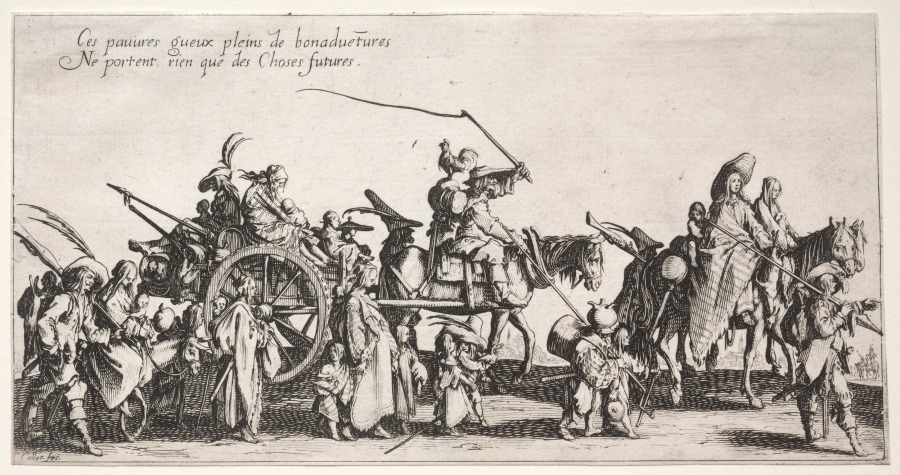
Jacques Callot, The Bohemians (Les Bohémiens), c. 1621–25, etching and engraving, 12.4 x 23.8 cm. Cleveland Museum of Art, John L. Severance Fund, 2004.42. https://www.clevelandart.org/art/2004.42

This text examines who truly speaks when the Roma are spoken about, and who controls their visibility across history and media. Through an analysis of the term “Gypsy” versus the self-chosen name “Rom”, archival constructions from Cosmographia to press photography, and contemporary expert classifications, the author shows how Roma identity has for centuries been shaped from the outside, through majority projections, rather than through the community’s own voice. The conclusion is that the Roma belong to themselves, yet archives, media, and researchers still too often stand between that voice and the audience that ought to hear it.

Tekst propituje ko zapravo govori kada se govori o Romima i ko kontroliše njihovu vidljivost u
medijima i istoriji. Kroz analizu naziva ``Ciganin`` nasuprot samoodređenju ``Rom``, arhivskih
konstrukcija (od Kosmografije do fotografija u štampi) i savremenih ekspertskih klasifikacija,
autorka pokazuje kako je romski identitet vekovima oblikovan spolja, kroz projekcije većine, a
ne kroz sopstveni glas zajednice. Zaključak je da Romi pripadaju sebi, ali da arhive, mediji i
istraživači i dalje prečesto stoje između tog glasa i publike koja bi trebalo da ga čuje.

Who actually speaks when we speak about the Roma? Who chooses the word, the moment it appears in the media, who decides whether a story is told or passed over in silence? That question is the starting point for thinking about the long history of Roma representation in Europe.

The Name as the First Battlefield

The word “Gypsy” (German Zigeuner, BCMS Ciganin, plural Cigani) did not arise from within; it was created and reinforced for centuries by the majority, while “Rom” comes from within the community itself, an act of taking the name back. Klaus-Michael Bogdal, in his study of how Europe invented the Gypsy, showed something that never stops unsettling me: the image we recognize today as “Gypsies” is not a description of reality, but a construction, assembled over centuries out of fear, exoticization, and the majority’s need to place its own projections somewhere. That construction has an archive, reaching back to Sebastian Münster’s Cosmographia of 1550 and Dillmann’s Zigeuner-Buch of 1905, long read as sources of knowledge about a people, when in fact they were a mirror of the majority itself.

That archive can also be outright false and still keeps being passed down. An illustration linked to the so-called Sclavi Țigănești, still cited by Romani scholars, remains disputed: it is not certain that it is authentic in the form in which it circulates. Yet even if it is not what it claims to be, it still points to something historically confirmed: the slavery to which the Roma in Moldavia and Wallachia were once subjected. Invented and real stand side by side, and that closeness shows how hard it is to separate them in Roma history.

The World as Picture, the Press as Its Continuation

Heidegger argued that the essence of the modern age is not that one picture of the world replaced another, but that the world itself became a picture, something a subject frames and thereby conquers. Whoever pictures the world rules it. For the Roma, that formula has to be inverted: they become the picture, but never the one who pictures. Where the photograph stops, language takes over the relay; press micro-frames such as spatial precarity, crime, or victimhood do the same work, letting the reader possess the Roma as a known category without ever letting them set the terms under which they are seen.

David Mayall summed this up sharply: every image of the Gypsy is in one way real, since the Gypsy becomes whatever the writer imagines, and confirmation can always be found for whichever definition suits the purpose (Mayall, 2004). Long before him, Romanian-American writer Konrad Bercovici opened his book on the Roma with a confession that could stand for the whole European tradition: they have lived beside us for centuries, from Egypt to England, from Russia to America, and we still neither know nor understand them (Bercovici, 1930: 13). Written in 1930, it could have been written today.

Silence or the Chaos of Visibility in the Press

As early as 1983, Rüdiger Vossen included, in a volume on the Roma and Sinti between persecution and romanticization, a chapter by Michael Peters on the image of the Gypsy in the German press between 1981 and 1983, one of the earliest systematic readings of a pattern that repeats for decades: silence when there is no crisis, heightened visibility when a crisis breaks out. Silence was never neutral, it was a form of control, and the louder visibility that followed, in both the socialist and post-socialist press, rarely meant more accurate knowledge of the people it concerned.


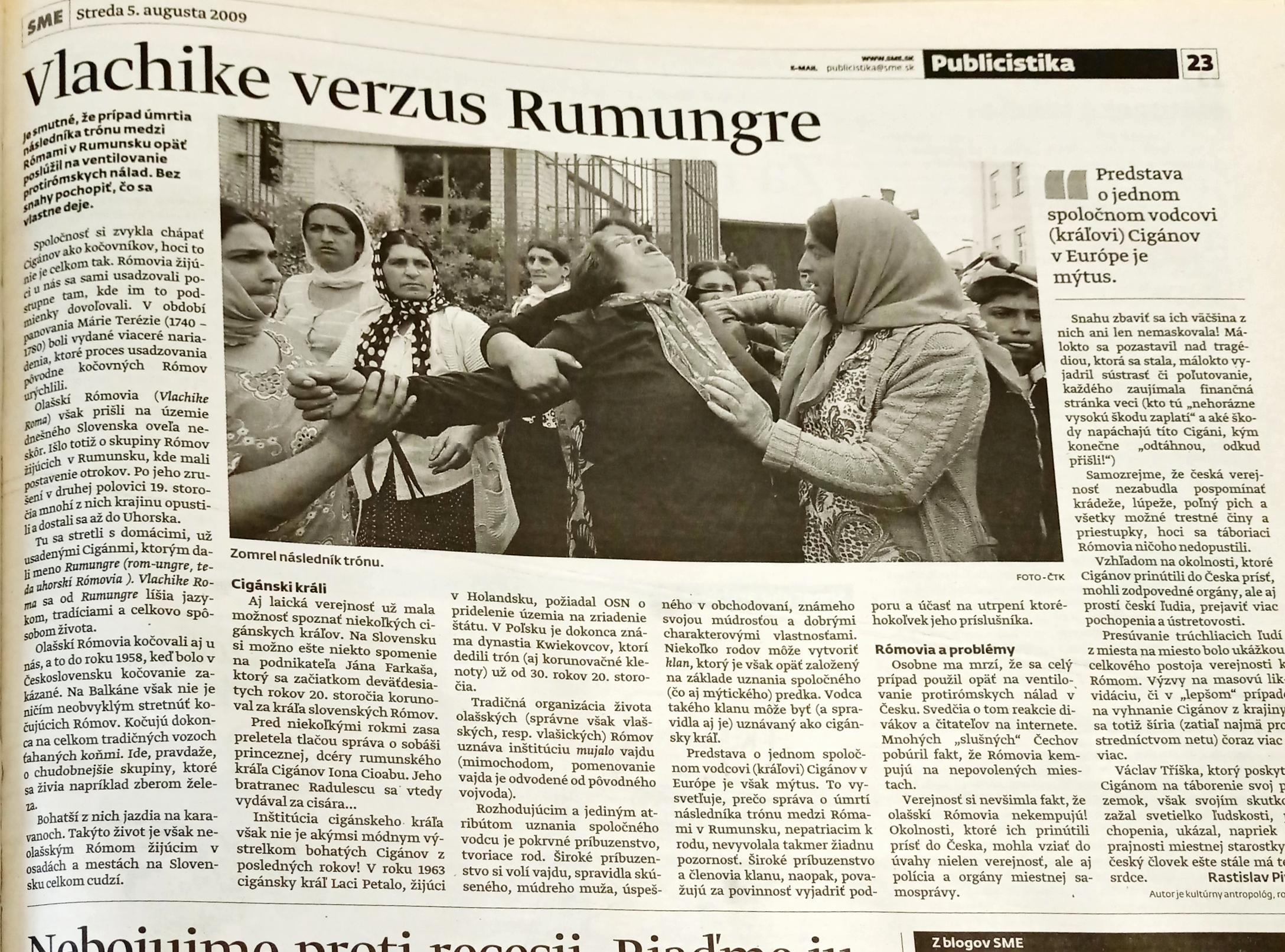
Text accompanying a photograph from the Slovak daily newspaper Sme, 5 August 2009

Whoever Counts, Rules

The same logic of naming and framing continues in our own century, only by other means. Sociologist Mihai Surdu, in his 2016 book Those Who Count, shows that expert reports, for all their scientific form, do what old censuses once did: they classify and count, producing the very boundaries of the group they claim only to describe. Tellingly, the photographs accompanying such reports almost never carry the disclaimer the text does, as if the image, unlike the word, could not lie.

Instead of a Conclusion

The answer to whose the Roma are is, of course, simple: the Roma belong to themselves. But the archives and media narratives through which European history passes, from Byzantine records that mention them long before the Cosmographia to Bercovici’s confession of ignorance and today’s policy reports, still too often behave as though that were not the case, as if the right to a name and an image were something others get to decide. The task of the researcher is not to give someone a voice, that voice has been there all along, but to stop standing between it and the audience that ought to truly hear it.

References

Bercovici, Konrad. The Story of the Gypsies. 1930, p. 13.

Bogdal, Klaus-Michael. Europa erfindet die Zigeuner: Eine Geschichte von Faszination und Verachtung. Berlin: Suhrkamp, 2011.

Dillmann, Alfred. Zigeuner-Buch. Munich: Wildsche, 1905.

Heidegger, Martin. „The Age of the World Picture.“ In: Off the Beaten Track.

Mayall, David. Gypsy Identities 1500–2000. London: Routledge, 2004.

Münster, Sebastian. Cosmographia. Basel, 1550.

Peters, Michael. „Zigeuner im Spiegel der Presse.“ In: Rüdiger Vossen (ed.), Zigeuner: Roma, Sinti, Gitanos, Gypsies zwischen Verfolgung und Romantisierung. Frankfurt am Main: Ullstein, 1983.

Surdu, Mihai. Those Who Count: Expert Practices of Roma Classification. Budapest: Central European University Press, 2016.

Published: 30.07.2026